
I was sitting at my desk at school when my ears perked up—a few of my middle school students were talking about some explicit scenes from a young adult book that most of them had read: Icebreaker, a romance about a college hockey player and an ice skater. “There’s no way my mom would let me read that,” one girl said. “Tell me more.”
Even if you don’t allow your kids to do or see certain things, they’re still hearing about them—or discussing them. Here are 6 topics kids talk about, whether you’re part of the conversation or not.
Books That Might Make You Blush
Kids are going to want to read what everyone else is. When one of my students brought a Colleen Hoover book to school, three or four girls asked to borrow it.
No idea what kids are reading? Check out the adult bestseller lists, not just the young adult ones. And ask your child what books are popular with her friends right now and whether or not she’s interested in reading those books too. Say something like, “What are your thoughts on [insert topic you know is in the book]?” That way you can have a real conversation—instead of just, “This book is bad!”
The Big One
Of all the topics kids talk about, sex is the one that gets the most distorted when sifted through their still-maturing minds. They just aren’t emotionally or mentally developed enough to have real conversations about it with each other. When they do talk about sex, it’s often based on what they’ve picked up from social media and the internet without much nuance. And sometimes what they find isn’t even factual.
Mental Health and Self-Diagnosis
Kids are constantly exposed to videos and posts about mental health—many of which offer misleading information. It’s not uncommon to hear students say, “I think I have ADHD,” or “I’m probably depressed,” based on something they saw on social media.
Even if your child doesn’t have her own social media account, these conversations are still happening all around her. Combine that with the very real physical and emotional changes of puberty, and it’s no surprise kids may turn to friends or social media influencers instead of their parents for guidance. That’s why it’s so important to talk openly about mental health, as well as sex and puberty, so your child knows they’re safe, normal topics to bring up with you.
Political Issues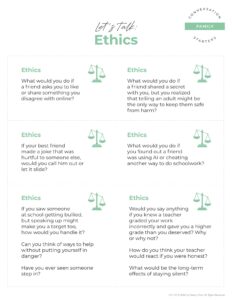
Middle schoolers talk politics—and most classrooms are just as polarized as the country. If politicians are fighting about something, kids probably are too. If your children want to talk politics at school, and you’re OK with it, consider what you’re modeling at home. Do you demonstrate respect, even when others disagree with you? Do you model anger? Or a spirit of public service?
You can also suggest that your kids don’t talk politics, and explain to them that political beliefs can, unfortunately, cause friction in relationships.
If you want some help with broaching difficult conversations with your teen, download our Ethical Dilemma Conversation Starters printable and get started today.
Online Realities
Your child may not have social media accounts. Or he might have accounts you don’t even know exist. (And kids can still see and talk about content via text, regardless.) Just because your child doesn’t have access to social media at home doesn’t mean he isn’t talking with his friends about trending topics he sees on friends’ phones or other platforms online. Plus, when kids hang out, they’re always handing each other their phones and saying, “Look at this!”
If your child does have permission to be on social media, make it part of the deal that you get access to his accounts. Use what you see to keep a running dialogue going. Accounts or no accounts, you have to assume your child is looking at social media in some way.
Hard News
It’s OK to want to protect our children from the harsh realities of the world, but if we don’t discuss the news with them in an age-appropriate way, the perspective they get will come from their peers.
Kids are talking about school shootings, war, and other tragedies, and they need to process those feelings with you—not just their peers. They need your guidance and reassurance to feel safe and supported.
In all of the topics kids talk about, if we stay aware, we’ll be ready to engage, encourage, and guide our children. They may be hesitant to bring these topics up at home, so it’s also up to us to get the conversations going.
How do you stay up-to-date on topics kids talk about?