“I don’t know when Nate’ll get his license,” my friend Cassie told me. “A few months back, he stepped on the gas instead of the brake and hit a pole. Now he doesn’t want to get behind the wheel again.” I admitted to her that my son isn’t in a hurry to get his license either. Apparently, it’s a thing with Gen Z. But I want my son to have more responsibility—like going to the grocery store to pick up milk. Or driving himself to school or to his friend’s house. But it’s not easy giving responsibility to a teenager who doesn’t want it. How do we teach responsibility to a teenager when we’re in this situation?
We can’t give up though. Having responsibility is good for teens and brings confidence. Here are 5 ways to teach responsibility to a teenager, even if he’s reluctant to have it.
1. Encourage leadership roles both outside and inside the home.
My son’s friend ran for class treasurer because he wanted to help make important decisions for his sophomore class. But leadership comes with responsibility, and not every teen will jump at the chance. Still, even small leadership experiences—like section leader in the band, team captain, or patrol leader in Scouts—can build confidence and self-esteem. If your teen is quieter, or hasn’t sought out leadership yet, look for ways he can have more responsibility at home.
Make your teen the meal planner once a week. Or give him the role of tech support leader. Other roles could include sibling tutor, game night coordinator, laundry leader, and pet care captain.
2. Let her handle her own schedule and appointments.
These little tasks can be great for teaching responsibility to your teenager. Psychologist Lisa Damour, PhD, said on her podcast that she has had her daughter schedule her own hair appointments. Her young teen has to call and book the appointment on a day that fits her schedule and then add it to the family calendar. Dr. Damour then lets her walk to the salon (but gives her the money to pay). It sounded like her daughter was nervous in the beginning to call but has since gotten comfortable with it as her confidence has grown.
If your daughter’s bike (or car) needs maintenance, have her call the shop to schedule it. Your teen can also schedule dentist appointments, driving lessons, and the dog’s grooming or vet appointments. Try not to correct her if she makes mistakes!
3. Allow him to make (and defend) his own rules.
My son’s been asking for more freedom around screen time as he’s gotten older. But there’s only so much time in the day! (That’s my argument). But because teens have harder assignments and schedules in high school, they probably want the house rules to grow with them too. To teach your teenager responsibility, have him propose his own rules and then have him defend why he thinks they’re fair. Giving kids some control over their boundaries encourages self-motivation and responsibility. You can negotiate the terms together.
Some rules that could be up for discussion can include curfew, video game, and screen time, lifting parental controls on devices, using the car, and time spent at friends’ houses.
4. Encourage her to earn and manage her own money.
When I turned 11, I took an American Red Cross Babysitting Course and started babysitting my next-door neighbors. The Red Cross still offers babysitting classes today. A part-time job is a great way to teach responsibility to a teenager because they have to answer to another adult and finish tasks assigned to them. When she worries about showing up on time for her shift, you know she’s already learning more about responsibility! And once she earns her own money, you can teach her how to create a budget to save, spend, and share her earnings.
If your teen’s a swimmer, have her look into lifeguarding. Other ideas include dog-walking, landscaping, serving, bussing, tutoring, and working at the local grocery store, juice shop, pet store, or library.
5. Talk through tough choices with him.
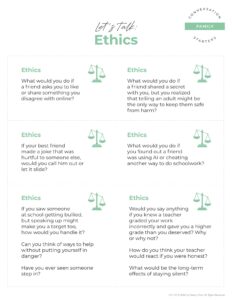
Your teen has probably had practice deciding what classes to take and who he wants to hang out with. But we can also teach kids about responsibility by having tough conversations (both real and imaginary) involving moral and ethical choices. Teens don’t just learn responsibility through leadership roles and tasks. It’s also about thinking through situations that may challenge their beliefs and values, weighing the consequences, and then making sound decisions.
Over dinner or a car ride, ask questions like, “What would you do if a friend wanted to borrow your homework?” and “If a friend said he felt depressed, but didn’t want you to tell anybody, what would you do?” Having conversations like these can push kids past blind rule-following and into accepting responsibility. Print out our free conversation starters for more ideas!
Can you think of other ways to teach responsibility to a teenager?